Why start with protecting data-in-transit?
A crypto inventory tells you what to migrate and is therefore very much needed. But it doesn’t protect anything while you build it. Encrypt data-in-transit now, so the traffic recorded today stays safe while you build your inventory.
1. Recorded traffic can’t be recalled
An attacker needs a breach to steal data at rest, but only a tap to record data in transit. Traffic recorded during an 18-month inventory stays exposed forever. Network encryption stops that build-up now.
2. Inventories take a long time
Discovering, analysing and prioritising across a whole organisation takes months to years. Encrypting a handful of critical links is a project with a defined scope. Don’t let the slower task block the faster one.
3. You don’t need the inventory to know your most exposed links
Data centre interconnects, site-to-site links, cloud connections and satellite links are already known. Encryption at the network layer protects all traffic on a link, whatever the applications use, so it doesn’t depend on discovery results.
4. It protects what the inventory will flag as hard to fix
Legacy systems, OT and ICS, embedded devices and third-party connections will show up in the inventory as hard or impossible to migrate. Encryption at the network layer already covers them.
5. It buys time for an orderly migration
Once traffic on your critical links is protected, migrating each application can follow the inventory’s priorities instead of deadline panic. That means fewer emergency projects and lower cost.
6. There’s little regret risk
A crypto-agile software engine can switch algorithms as standards change, so acting early doesn’t lock you in.
7. It gives you measurable progress to show
Auditors, boards and regulators see a deployed control, not just a plan. That carries weight under frameworks like DORA and NIS2.
8. The two steps don’t compete for resources
Network teams deploy encryption while IAM and security teams run the inventory, so both can move in parallel.
Want to learn more about crypto inventory?
Building an inventory is a big task. We can help you discover your Secure Shell related assets and configurations.
Protect long-lived data-in-transit with a PQC powered network encryptor
Critical organizations have the obligation to protect long-lived data against present and future threats. The good news is your organization does not need a market-wide quantum-safe rollout or a finished standard to get going. You also don’t need a finished crypto inventory to start.
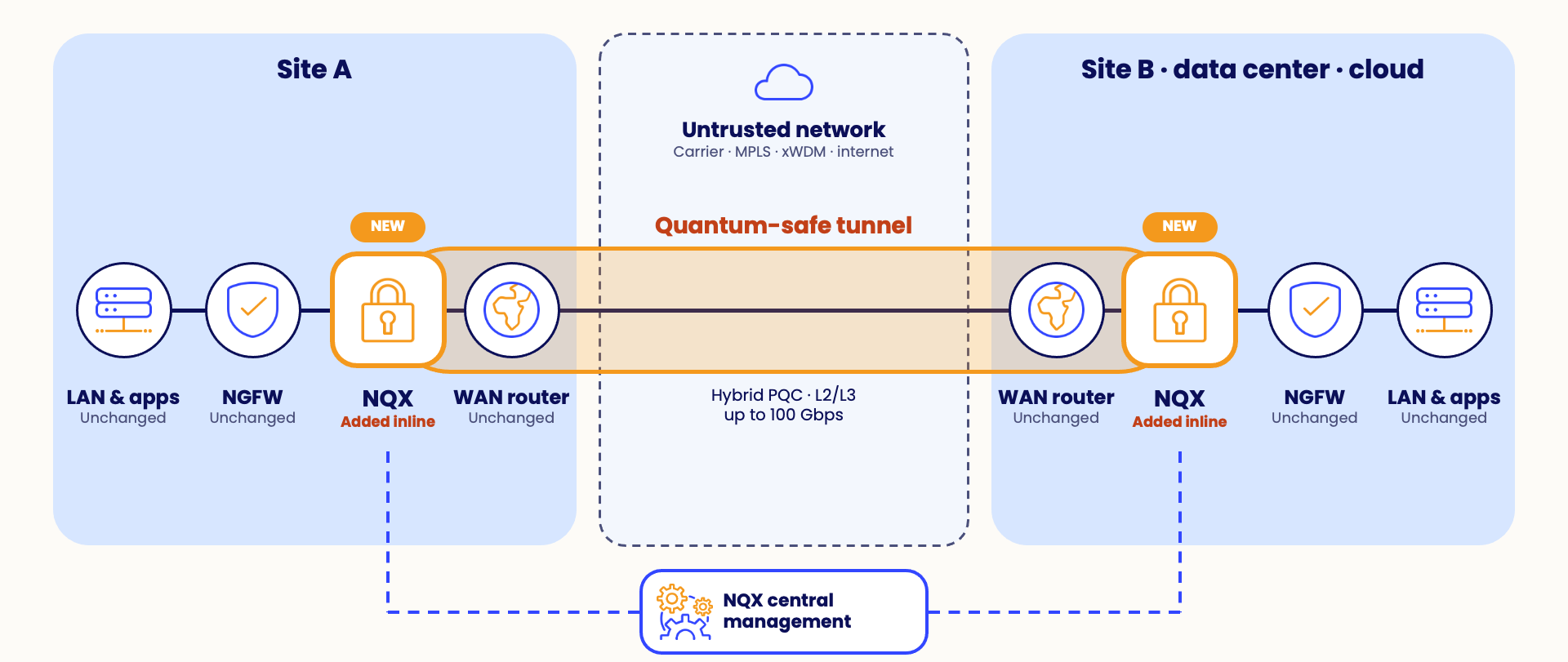
With quantum-safe network encryption, you build resiliency and protect data in transit against harvest now, decrypt later while building your inventory. With a network encryptor like NQX, you can:
embed any data traffic inside a quantum-safe overlay at the network level (L2/L3)
protect all traffic, starting from the network backbone all the way to the application layer
secure app-to-app, site-to-site, data center to data center connections over untrusted networks with a single solution
keep your infrastructure intact and quantum resilient
Learn more about PQC for data-in-transit
Different approaches to quantum safety
Quantum computing poses different risks to different encryption methods. Explore our comparison page to understand your options and why choosing the right approach to quantum safe cryptography matters for your company. Compare different different approaches to become quantum safe.
Network encryption complements firewalls and VPNs
Network encryption based on PQC complements your installed base. Learn more about how our NQX Network Encryptor offers high-throughput quantum resiliency while allowing firewalls and VPNs to do what they do best. How NQX Network Encryptor complements firewalls and VPNs.
A pragmatic first 90 days
01 Prioritize data in transit
It's where harvest-now-decrypt-later hits first, and where protection can be added without changing systems
02 Require crypto-agility
In anything you procure, so evolving standards never force a rip-and-replace upgrade.
03 Align with your mandate
EO deadlines, NIS2, DORA, ECB supervisory expectations — know which applies and what evidence you'll need to show.
04 Inventory
While protecting data in transit, build your inventory and Cryptographic Bill of Materials (CBOM).
05 Map exposure
Which sensitive data crosses which links, and how long must it stay confidential?
Learn more about NQX Network Encryptor
NQX™ is a TL III (EU Confidential) certified quantum-safe network encryptor that protects data in transit at Layer 2 (Ethernet) and Layer 3 (IP) at up to 100 Gbps line rate.
Frequently Asked Questions
PQC migration FAQ
It means that data moving between sites, data centres and clouds is encrypted with algorithms that resist attacks from both classical and quantum computers. In practice, the vulnerable part is the key exchange (RSA and elliptic-curve methods), which is replaced or combined with post-quantum algorithms such as ML-KEM (NIST FIPS 203).
Because data in transit is the easiest to harvest. Stealing data at rest requires a breach, but recording traffic only requires access to the network path. Traffic recorded today cannot be recalled, so every day without quantum-safe encryption adds to what can be decrypted later.
No. A crypto inventory is essential for planning your migration and is increasingly a compliance requirement (for example under PCI DSS 4.0 and DORA), but it doesn’t protect anything while you build it. Encrypt your most exposed links now and run the inventory in parallel.
Start with links that carry high volumes of long-lived, sensitive data: data centre interconnects, site-to-site and branch links, cloud interconnects, satellite links and OT backhaul. These are usually known without a full inventory.
Quantum-safe migration is an opportunity to own your encryption. We can guarantee that keys are generated and held in your infrastructure, are non-exportable, and stay under your organization's control. This is a growing requirement for government, defense, finance, and critical infrastructure in Europe.