For years, privileged access management (PAM) focused on protecting human administrators. The biggest concerns were compromised credentials, privileged insiders, and ensuring that administrators had only the access they needed to perform their jobs.
That world has changed.
Today, the majority of privileged activity in many organizations is no longer performed by people. Applications, cloud workloads, Kubernetes clusters, APIs, CI/CD pipelines, automation platforms, and increasingly, AI agents are continuously authenticating to systems, accessing sensitive resources, and performing privileged operations without direct human involvement.
These entities—known as non-human identities (NHIs)—have quietly become one of the fastest-growing and least-governed attack surfaces in the enterprise.
The Explosion of Machine Identities
Every modern application depends on machine identities. Every container, service account, API, cloud workload, serverless function and automation workflow requires the necessary privileges to authenticate and communicate with other systems.
Unlike human users, these identities are created dynamically, operate continuously, and sometimes exist for only minutes or hours before disappearing. As organizations build cloud-native architectures and adopt modern DevOps practices, the number of NHIs has grown exponentially.
Industry research illustrates the scale of this shift. Non-human identities now outnumber human identities by as much as 144 to 1, while the total number of NHIs continues to grow by more than 44% year over year. At the same time, AI service credential leaks increased 81% in a single year, highlighting how rapidly organizations are expanding machine-driven infrastructure without corresponding improvements in governance.
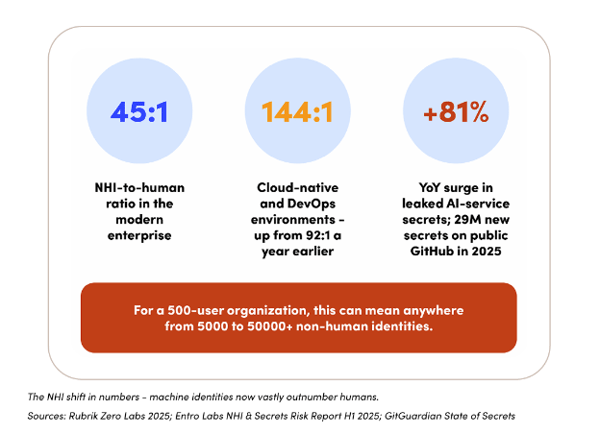
For a typical 500-user organization, this can translate into anywhere from 5,000 to more than 50,000 non-human identities that require authentication, authorization, and lifecycle management.
Why Traditional Security Models Fall Short
Traditional identity security was designed around people. Users authenticate, receive permissions, complete their work, and log out.
Machine identities don't operate that way.
They run continuously, communicate autonomously, and often authenticate using long-lived credentials such as API keys, service account passwords, certificates, or embedded secrets. Many organizations have little visibility into which machine identities remain active, what they can access, or whether those privileges are still appropriate.
The result is an expanding attack surface that is difficult to inventory, monitor, and control.
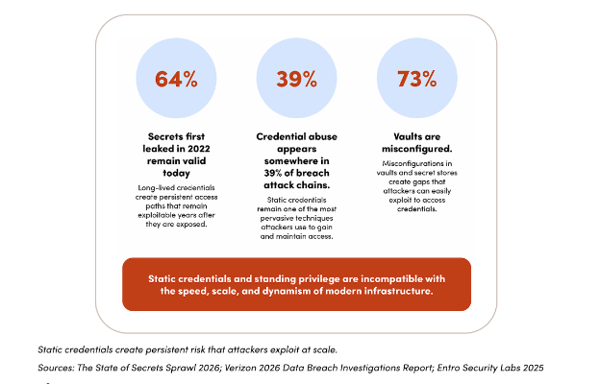
Credentials first exposed years ago often may remain valid today, while credential abuse continues to appear in a significant percentage of breaches. Long-lived machine identities accumulate privileges over time, creating persistent pathways that attackers can exploit if credentials are compromised.
AI Raises the Stakes
The emergence of AI agents introduces another layer of complexity.
Unlike traditional software that executes predefined instructions, AI agents make decisions, invoke APIs, interact with infrastructure, and perform tasks autonomously. They increasingly operate on behalf of users, making privileged decisions at machine speed.
This changes the security conversation.
Historically, organizations focused on preventing unauthorized access. With AI agents, the greater challenge may be governing “authorized” identities that make unintended decisions or perform actions outside expected policy.
The question is no longer simply "Who has access?"
It has become:
- What is this identity allowed to do?
- Under what conditions?
- For how long?
- Can those permissions change while activity is in progress?
These questions require continuous authorization rather than one-time authentication.
From Privileged Access Management to Runtime Identity Control
Managing non-human identities requires organizations to rethink privileged access.
Instead of relying on static credentials and standing privileges, modern security architectures increasingly emphasize short-lived identities, identity-bound sessions, policy-based authorization, and continuous monitoring throughout the lifetime of every privileged interaction.
This evolution represents a shift from traditional Privileged Access Management toward what many organizations are beginning to refer to as Runtime Identity Control.
In this model, access is not granted once and forgotten. Every privileged request is continuously evaluated based on identity, context, target resource, and organizational policy. Human users, workloads, automation platforms, and AI agents are all governed using the same Zero Trust principles.
Preparing for the Machine-Driven Enterprise
Non-human identities are no longer an emerging trend—they are already the dominant source of privileged activity in many organizations.
As cloud adoption accelerates and AI becomes embedded in everyday operations, organizations must extend identity governance beyond human users. That means treating workloads, services, automation, and AI agents as first-class identities with strong authentication, least-privilege authorization, complete auditability, and continuous runtime control.
The future of privileged access isn't just about securing people.
It's about securing every identity—human or machine—and ensuring that every privileged action is verified, authorized, and governed from beginning to end.
Read the full Whitepaper: What AI Agents and Non-Human Identities mean for PAM | SSH >>>
Learn more about our Just-in-Time PAM solution >>>